Tuesday, 6 January 2015

More POMs in Tasmania


Following the Derwent River from Hobart we came to the town of New Norfolk. We passed glittering rapids, salmon ponds, tall rows of hop frames and vines, historic Oast houses and boarders of populars.

We arrived in Fentonbury and met up with Charly (who came to visit us in Borneo last Easter) and her boyfriend Eric. They were staying in a pretty little hoilday cottage next to Eric's parents' house which they own and manage. It was very beautiful up there, lush green forests and mountain springs. The air was so clean it was almost like being in a dream. We stayed two nights and went on three walks. The weather was great. 

We went for a walk up in the Mount Field National Park among extensive stands of ancient plants of Gondwanan origins. A winter ski resort has been established on the highest peaks. Gnarled pines twisted their trunks through splinted rocks. Peaty heathland and alpine plants covered the higher mountain saddles. Lower down the lake shores were teeming with Pandani groves - a spiky palm.


Admiring the views over Lake Dobson in Mount Field National Park


Pandani groves surround the lower lakes


A Bennets Wallaby waits for us above the car park

Pademelon in full flight - the smallest wallaby species in Tasmania

Charly and Eric treated us to a delicious BBQ on the front porch in the settling sun. There were many kookaburras in the garden, and pet lamas in the neighbouring field. 


Home sweet home

The following day we took a stroll around Lake St Claire. It is apparently the deepest lake in Australia. It was carved out by several glaciations over the last two million years. Lake St Claire is the headwaters of the Derwent River and it was ringed by dramatic peaks and dense forest. We scanned the lake edges for signs of a platypus but didn't see any. 

One of many hydroelectric systems in central Tasmania, dating back to the 1920s and 30s, some of the earliest in the world

Lake St Clair in the sunshine


Silver wattle - named after the silvery hairs covering the foliage

Sarah contemplating Tasmania's natural beauty


A flame robin


The clear water's of Lake St Clair are teeming with fish and tree debris brought down by the rivers that feed it


The humid forests are teeming with fungi even during late spring


Spink bask in sun on fallen trees...


.....or on the soft moss which covers the foliage and forest floor


On our last day we spotted five echidna deep in secluded forests. They are SO cute!!!! 


Road Trip heading home

Monday, 5 January 2015

Hanging out around Hobart

Hobart is Tasmania's capital city and we got to know it as our home city during our stay. It sits beneath Mount Wellington and on the Derwent Estuary. It is a relatively small city and easy to navigate around. The waterfront area and harbour is a pretty focal point with numerous fresh seafood shops and floating 'fish take-aways'. We tried some fish and chips and found that they use a breadcrumb rather than a batter, quite inferior to the British classic!

We visited Salamanca Market, which is held every Saturday. The market is very close to the waterfront set against a backdrop of 1830's sandstone warehouses that are now converted to cafés, bars and restaurants. All sorts of local crafts and food were touted, intermingled with busking entertainment acts.

There were so many local attractions on offer around Hobart, but unfortunately many of them had rather hefty fees attached. 11km south of the city we climbed up the circular staircase inside The Shot Tower to take a panoramic view of the Derwent Estuary. The tower is 58m high and was built of local sandstone in 1870. It was used for the production of lead shot for the muskets and rifles of the day. A molten lead mixture was poured through a sieve at the top of the tower and it formed into balls whilst falling to the ground. Chris counted the steps on the way back down; 259 in total.


Cross section sketch of the shot tower

Going up......!


Views over the Derwent Estuary 

We also visited Fossil Cove on the Derwent Estuary. A steep track wound down to the creek and two wallabies bounded away from us into the bush. We reached a handsome secret cove. It was flanked by a large rock arch on one side. We explored the wave cut platform to find the coves namesake in the form of layers of sea fans. Tim and Chris amused themselves skimming stones into the waves. Tim also suggested we all sampled some mussels straight off the rocks - raw! Thankful we did not suffer any bad effects. 


Tim modelling this summers fashions

Sarah and Tim at Fossil Cove

Ancient sea fans fossilised in the rock cut platform

Can you spot Chris?


Tim found his first fossil!


Stone skimming competition 

We continued further down the estuary to a seaside town called Snug. From the highway we walked down the Snug River track which seemed to be a haven for water birds. We kept a watchful eye out for platypus but we weren't lucky. We did spot a juvenile pufferfish swimming upstream and got caught out by a shower!


An Oyster Catcher making the most of low tide


A collection of caterpillars


Huon Valley and Gliding on Air

We headed towards the deep south of Tasmania into the Huon Valley. This region has been shaped by a rich history of whaling, timber cutting, boat building and fruit growing. We passed many apple orchards, vineyards and some cherry orchards during our two hour drive to the Tahune Forest Reserve. Poised on the edge of the south-west wilderness, the forest has been an important economic driver to the area since colonisation.

It was interesting to learn about the logging quest for Huon Pine (named so as it was first found in this valley). These straight trunked trees grow incredibly slowly at a rate of 1mm per year. It's a rich smelling, warm creamy-golden wood which is highly prized for boat building due to its grain and anti-rot properties as it is insusceptible to marine borer or screw worm. Huon Pine can no longer be felled and is a protected species. The Huon Pine currently used for timber products is reclaimed from buildings or from old trees submerged in rivers or lakes.

We experienced the beautiful views of the forest canopy from a high walking platform that was suspended among the giants of the forest. The air walk took nearly an hour; we were impressed by the high wire engineering - which thankfully held our combined weight. These southern forests are dominated by Eucalyptus regnans, or Swamp Gum. These trees, like the legendary Phoenix, are born and destroyed in fire. Swamp Gum flourishes in the high rainfall. The largest recorded Swamp Gum in the Tahune Forest Reserve holds the record of the tallest hardwood in the world at 99.6m and has been called Centurion (obviously working to significant figures). 

At one point we walked out on a limb above the tree tops and saw the mighty Huon River rush beneath our feet. The confluence of the Huon and Picton Rivers was visible to the west. Ella was especially courageous to venture out on the limb and overcome her fear of the exposure. 

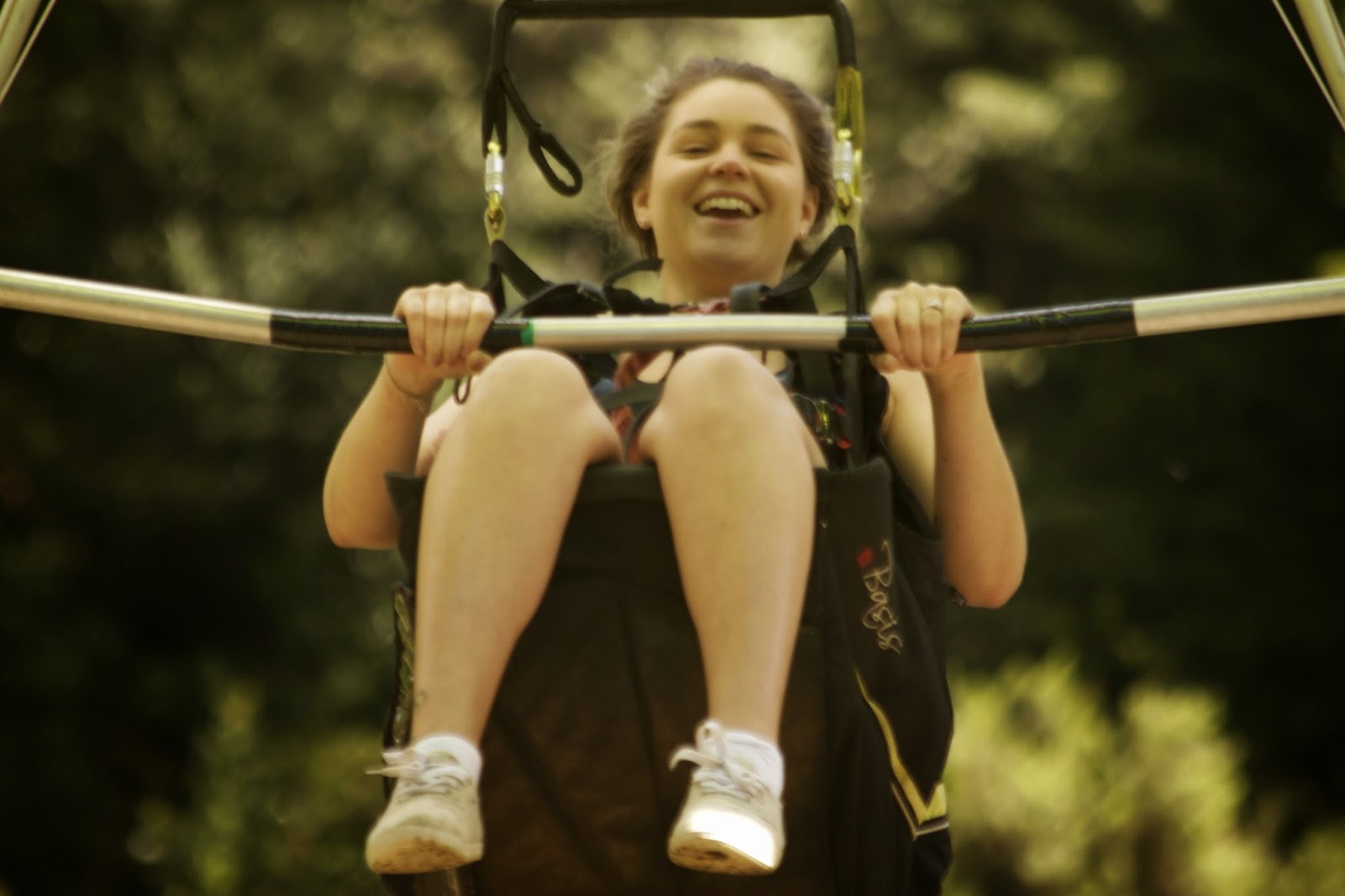
We also took to the air (almost) when we tried Eagle Hang Gliding. It was great fun and safe as we were controlled by wires. 

We then travelled further into the south, passing the town of Dover. It was in this deep bay that the first European navigators dropped anchor. When we arrived at Hastings Springs we were surprised to find a normal swimming pool when we were expecting something a bit more, well, natural. It was fed by pure spring water but you couldn't actually see the spring. It said that this attraction was 28C all year round, which I found a little optimistic, but it was good to relax in the pool. We were warmed by a tasty BBQ, expertly cooked by Chris on the publicly provided gas grills. 

A fallen giant

We each take to the skies!


Beautiful blue-spot moth

Walking amongst the tree tops

Views over the Swamp Gum canopy

The river water is stained brown with tannins but is clean and fresh

Confluence of the Huon and Picton Rivers

Out on a limb


Chef cooks up a treat 

Mermaids relaxing 


Saturday, 3 January 2015

Surfing Tasmania Style

Living the dream! Surfing with Tim on a deserted beach east of Hobart. The water was chilly so we were very glad we had wetsuits. Whilst the lads tackled the huge barrels, Sarah was the first to attempt and succeed at kayak surfing!


Cowabunga dude


A cheeky beer on the beach

Kayak surfing at its best!


.....and dismount!


Thanks Tim