Tuesday, 7 July 2015

Cusco and the Sacred Valley

A long and uncomfortable (too hot, too cold, manic driver) overnight bus journey brought us to Cusco at 7am. We were now at an elevation of 3300m and our breathing was laboured. We checked into our hostel on the main square. The room felt damp and unpleasant. We set about familiarising ourselves with the town. Due to the effects of the altitude we didn't walk too far.

In the old town the thickset walls and foundation stonework were immediately apparent. Much of the neater, rounded blockwork was part of the original Inca capital that was destroyed and rebuilt by the Spanish in the 15th century.

Cusco and the other archaeological sites of the Urubamba Valley (Ollantautaybo, Runcuracay, Sayacmarca, Phuyupamarca, HuiƱay Huayna, Intipucu etc) bear unique testimony to the Inca civilisation.

A few days later we took a taxi through the Urubamba (Scared) Valley, stopping at the town of Pisac, about 35km north east of Cusco. We visited the Inca citadel, which towered above this sleepy village along cliff-hanging footpaths. It was built built between the 10th and 11th centuries. We admired this Inca architecture due to the technique used to build its enormous walls, palaces and turrets with stone blocks, all done without any type of cement or adhesive.

Water is still channelled through the fully functional irrigation systems. Furthermore, the terraces that encircle the mountain were very impressive. When following a hanging footpath we went through a tunnel cut into the hill, about 15m in length. The site afforded marvellous views of the valley, and we could hear a children's party in full swing hundreds of metres below.

In the town of Ollantaytambo we saw a temple made of massive monoliths, and a fortress. What was interesting about this site was that at some point, for reasons unknown, work mysteriously stopped and the buildings were never completed. You can see blocks just left lying on the ground, and trace the ramp and road where along which they travelled from the quarry on the other site of the valley. 


The surrounding valleys have been cultivated continuously for well over 1,000 years. The farmers still grow potatoes and maize, but now use chemicals, and like many underdeveloped country's the control and effect of these substances are poorly understood by the masses. The natural vegetation is scrubby subtropical region ferns and palms. We spotted many eucalyptus trees, obviously an invasive species, but how they got here we don't know.


Cusco's central Plaza


Typical colonial style cloisters surround the plaza. Built in the early 1500s on the original foundations of the Inca city


Guinea Pig anyone?


Fraser and Sarah out exploring Pisac's ruins


The steep terraces of Pisac's fields that supported the Inca fortress


Sarah tied to the old hinges in the stone doorway


Beautiful stonework - no mortar required


Family outing in Olantaytambo


The ruins at Olantaytambo overlook the small fortified town


The prominent bulges on these stones are believed to have been used to help fix the ropes to the stones for moving them from the quarry, on the other side of the valley, to the site. The blocks would then have been ground off once the blocks were in position. As the site was never finished these bumps remain providing clues into the construction methods used.


The straight road on the edge of the fields leads to the quarry where the majority of the large stones came from


The original aqueducts and channels still function perfectly even 600 years later

Monday, 6 July 2015

Quyllur Rit’i Pilgrimage Part 3

The marching dancers and musicians began to pass our campsite at 2am. We stayed in bed until 4am and then, after a quick breakfast, set off in pursuit. We soon caught up to the back of the marching column. We were instructed to switch off our torches, leaving us in near-darkness. We found ourselves walking along between two lines of ghostly figures (the dancers and musicians). The musicians had stopped playing and so the only sounds were those of marching feet and the bells on the costumes of the dancers. It was a strange ethereal experience.

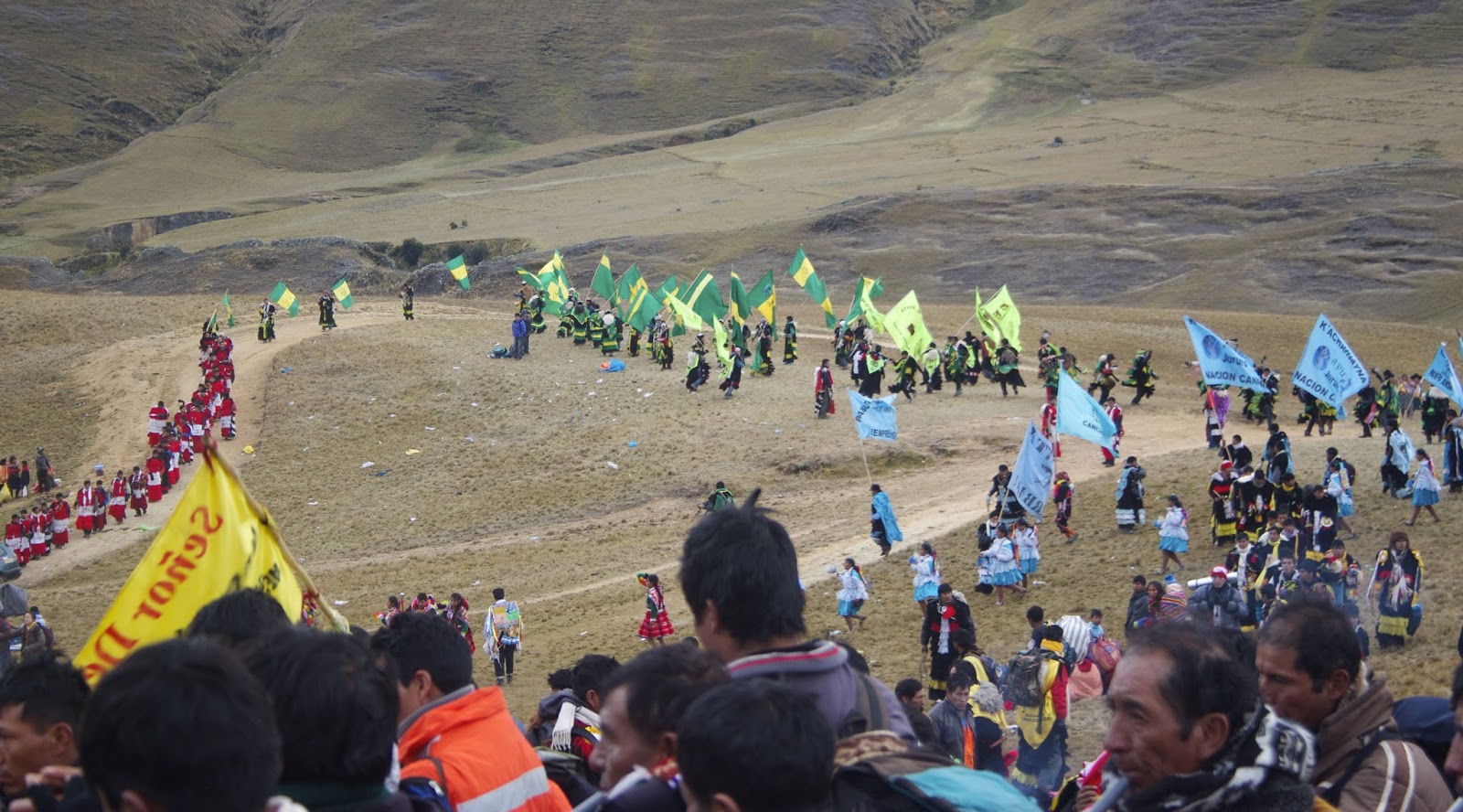
As the sky began to lighten, we reached a great ridge upon which all of the dancers were arraying themselves. The musicians stood in groups on the far side of the ridge, where we joined them. The dancers formed a huge line down the ridgeway, grouped by their geographical origins. This gave us a great opportunity to see the full variety of dancer costumes. Some of the dancers carried woollen baby llamas strapped to their lower backs, signifying their responsibility to nurture their herds. Others carried mini-me’s, dolls wearing the same dancing costume as the owner. One of the dancers explained that his doll represented the unborn child his wife is carrying back home. In five years, the child will be joining him at the main festival campsite and watching his/her father dance to honour the stars.

Other dancers have an authority role and carry whips to keep everyone in line. Though these get vigorously used as part of some of the dances, they are not used with any great anger to keep people in line. As a westerner, you are, at worst, likely to get nudged in the ribs by one as a prompt that there is a ceremony going on which requires you to remove your hat.

Unfortunately after several days, which apart from the brief rainstorms, had been almost completely clear, the sky was now heavily overcast. It was still possible to determine when the sun rose behind the clouds. The hubbub of conversation stopped and the dancers and musicians knelt to hail the rising sun. With the sun in the sky, the dancing ideally would have started, but there was a desire to wait until the assembly could feel the warming rays of the sun on their skin. So there was a hiatus as we waited, hoping that the clouds would part and allow the sun to shine through. This they stubbornly refused to do. So after half an hour everyone finally lost patience, the musicians began to play and the dancing began!

This was on a completely different scale to anything we’d seen before. We had watched in delight as small regional groups did their individual dances, with a range of symbolisms. This time, everyone danced at once in a huge display which soon encompassed the entire valley. We followed them down through the valley and up to another ridge where everyone stopped to pray. Then down into the next valley and up another ridge for another prayer stop. It went on and on. Finally everyone made their way down to a huge garden party where the dancers could remove their heavy woollen costumes and consume hot food and fizzy drinks.


We left the performers at this point and set off across country to meet our bus. At journey's end, we had a final superb lunch courtesy of Mauro. We ran down to a local petrol station and bought beers for everyone, to reward our guides and our hard working support team. Before drinking, we each poured a little beer onto the ground for Pachamama (the Earth Mother). Apparently she was thirsty too!

Tired pilgrims continue their dancing in the early hours

Kicking off the Quyllur Rit'i 2015 Fashion Parade

The outfits are fantastic


Erm...


Dancers following the ridge line curving away into the distance


Accompanied by a "mini-me" for his unborn child   


Very tired now, waiting for sunrise

The music continues its relentless beat


The weave up the hills and down the valleys

Even taxi was enjoying the show


The final ridge

Kneeling for prayers as the sun begins to rise

And then back down the hill towards home for tea and medals


A well deserved rest at the end of the trail